![[personal profile]](https://www.dreamwidth.org/img/silk/identity/user.png)
The Absinthe Ritual (a primer)
Sep. 5th, 2008 09:17 am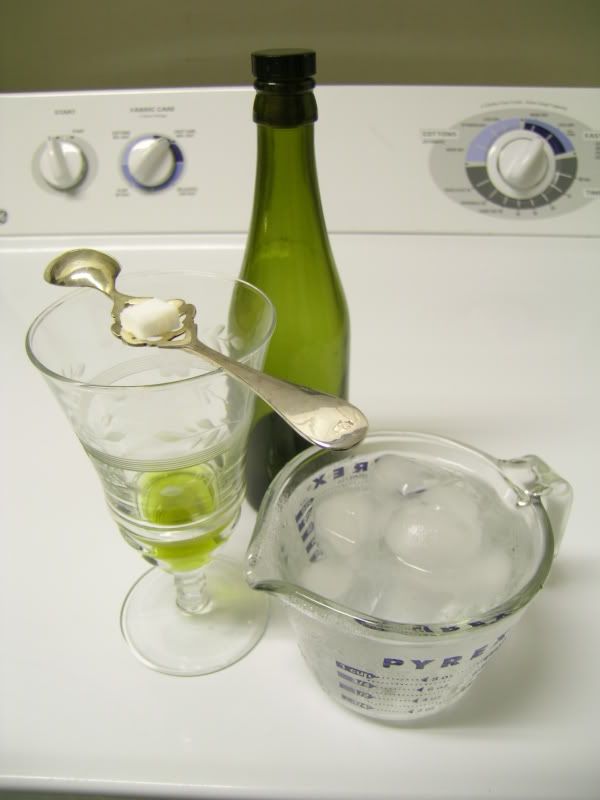 · Fill a small decanter, preferably one with a handle and a spout for an even, steady, and measured pour (Pyrex™ measuring cups perform beautifully), with ice and add water. Swirl to chill and let stand. With high quality absinthe the addition of sugar is completely optional. Personally I find a half a Domino™ cube to be sufficient, if I use it at all. Pour an ounce or two of absinthe (called a "dose") into a 8 - 10 oz. stemmed glass. Then set the spoon across the rim of the glass and place the lump of sugar on the grill centered over the opening of the glass. Proper accoutrements like a slotted spoon or a brouille are nice to have but a simple dinner fork with long tines is just as effective. · Fill a small decanter, preferably one with a handle and a spout for an even, steady, and measured pour (Pyrex™ measuring cups perform beautifully), with ice and add water. Swirl to chill and let stand. With high quality absinthe the addition of sugar is completely optional. Personally I find a half a Domino™ cube to be sufficient, if I use it at all. Pour an ounce or two of absinthe (called a "dose") into a 8 - 10 oz. stemmed glass. Then set the spoon across the rim of the glass and place the lump of sugar on the grill centered over the opening of the glass. Proper accoutrements like a slotted spoon or a brouille are nice to have but a simple dinner fork with long tines is just as effective. |
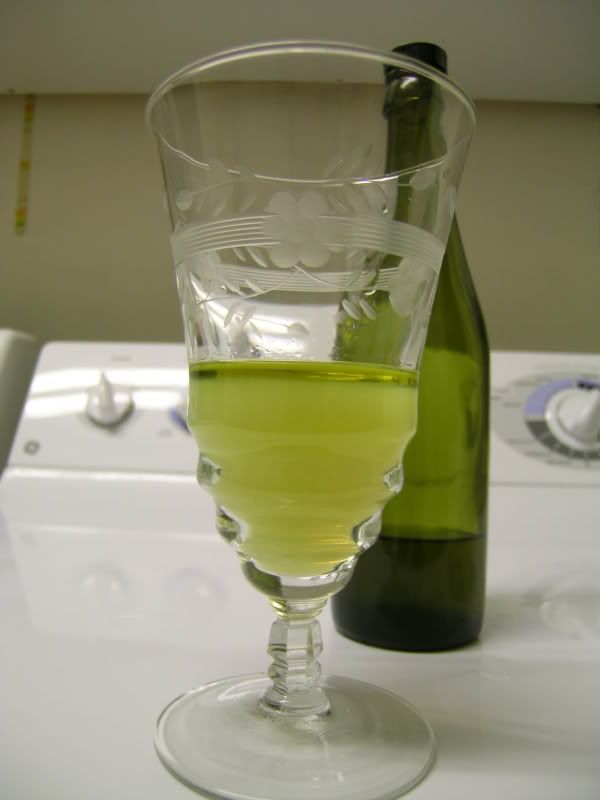 · Pour a dollop of chilled water over the sugar cube and allow a second or two for it to saturate (or dunk it in a spoonful of water), then gently and slowly pour water over the sugar cube until reaching an absinthe-to-water ratio of about 1:3 to 1:5 (1 part absinthe to 3 to 5 parts water). As the water and absinthe mix you will notice that the absinthe in the bottom of the glass begins to take on an opaque consistency. This is referred to as the "louche" (French for "shady") and it is caused by the essential oils (athenole) condensing into the bottom of the glass. Done with fine enough control (and more apparent without the interference caused by the spoon) the clear, un-louched absinthe will form a distinct layer at the surface that gradually gets thinner as water is added. · Pour a dollop of chilled water over the sugar cube and allow a second or two for it to saturate (or dunk it in a spoonful of water), then gently and slowly pour water over the sugar cube until reaching an absinthe-to-water ratio of about 1:3 to 1:5 (1 part absinthe to 3 to 5 parts water). As the water and absinthe mix you will notice that the absinthe in the bottom of the glass begins to take on an opaque consistency. This is referred to as the "louche" (French for "shady") and it is caused by the essential oils (athenole) condensing into the bottom of the glass. Done with fine enough control (and more apparent without the interference caused by the spoon) the clear, un-louched absinthe will form a distinct layer at the surface that gradually gets thinner as water is added. |
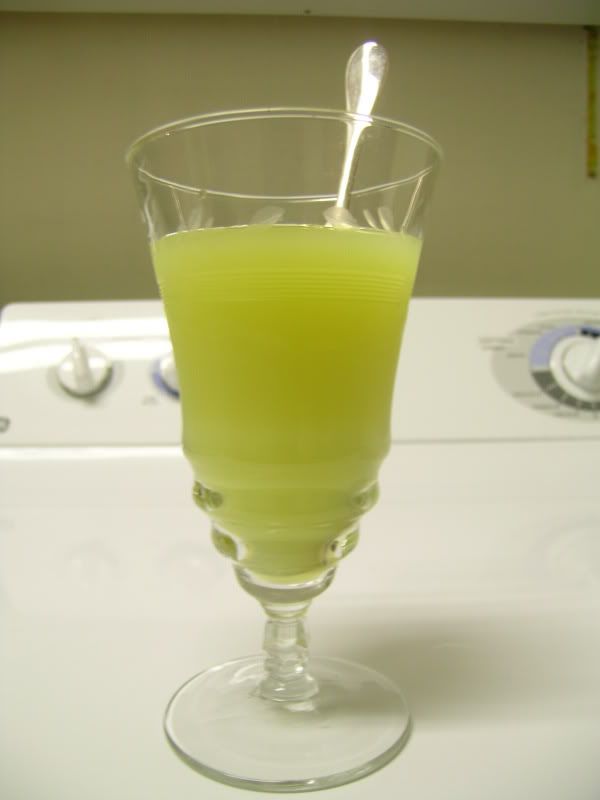 · Without using the ratios mentioned above, a "perfect pour" is achieved at the precise point where the clear layer of absinthe vanishes into the louche: Whereas all the essential oils have condensed out of the neat absinthe but are not diluted further than necessary (art is where nothing need be added or taken away from a piece to optimaize the user's experience). Obviously your personal tastes will be your best guide, more water or granulated sugar can always be added after the fact. Stir and enjoy! · Without using the ratios mentioned above, a "perfect pour" is achieved at the precise point where the clear layer of absinthe vanishes into the louche: Whereas all the essential oils have condensed out of the neat absinthe but are not diluted further than necessary (art is where nothing need be added or taken away from a piece to optimaize the user's experience). Obviously your personal tastes will be your best guide, more water or granulated sugar can always be added after the fact. Stir and enjoy!The louche should be rich and opaque in direct light (notice the spoon is not visible through the glass), and have a opalescent appearance when back lit. |
Whereas these are the characteristics of a quality absinthe, the true test of any absinthe is whether or not you like the flavor. The bouquet of anise should be the most obvious aspect without overpowering the bottom notes of "nutty" or "creamy" flavors contributed by the anise and fennel, or the top notes of "piney" or "spicy" imparted by the hyssop. Poor quality absinthes are bitter, or taste like toothpaste and have a thin louche, if at all. Absinthe is largely an herbal tincture and ought to be enjoyed as such, as an apéritif.
There is no historical president for burning absinthe! In my opinion its a waste of alcohol. But if you must get this sophomoric practice out of your system (I did!) set up the glass, the spoon, and the sugar as shown in the first picture reserving a measure of absinthe to be poured over the sugar cube. Light the cube allowing it to caramelize and drip in to the absinthe below before dropping the flaming sugar into the glass, igniting the absinthe. Quench that with chilled water of the same ratio. A better method is, after the bottle's empty to tip it on its side pointed away from you or anyone else and hold a lit match to the nozzle. . .whoosh! I assure you this stuff burns!


